
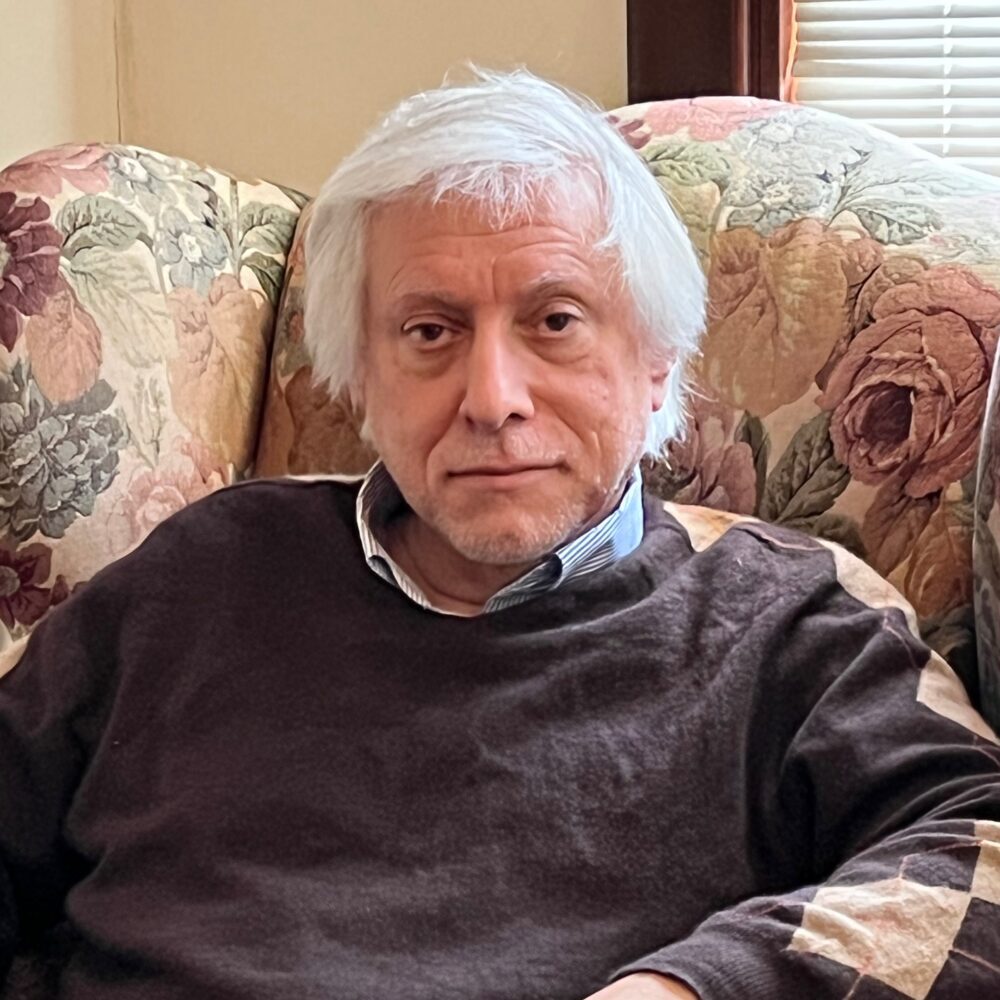
Gary Lloyd Noland
ClassicalAbout
GARY LLOYD NOLAND, founder of the Facebook groups Wild Composers and Composers with Big Egos, was born in Seattle in 1957 and grew up in a broken home in a crowded house shared by ten or more people on a plot of land three blocks south of UC Berkeley known as People’s Park, which has distinguished itself as a site of civil unrest since the late 1960s. As an adolescent, Noland lived for a time in Salzburg (Mozart’s birthplace) and Garmisch-Partenkirchen (home of Richard Strauss), where he absorbed a host of musical influences. Having studied with a long roster of acclaimed composers and musicians, he earned a Bachelor’s degree in music from UC Berkeley in 1979, continued his studies at the Boston Conservatory, then transferred to Harvard University, where he added to his credits a Masters and a PhD in Music Composition in 1989. His teachers in composition and theory have included John Clement Adams (not to be confounded with composers John Coolidge Adams or John Luther Adams), Alan Curtis (harpsichordist, musicologist, conductor, and one of the musical “stars” in Werner Herzog’s film on Gesualdo, “Death for Five Voices”), Sir Peter Maxwell Davies (Master of the Queen’s Music from 2004-16), William Denny (student of Paul Dukas), Robert Dickow, Janice Giteck (student of Darius Milhaud and Olivier Messiaen), Andrew Imbrie (1995 Pulitzer Prize Finalist, student of Nadia Boulanger and Roger Sessions,), Earl Kim (student of Arnold Schoenberg, Ernest Bloch, and Roger Sessions), Leon Kirchner (1967 Pulitzer Prize winner, student of Arnold Schoenberg and assistant to Ernest Bloch and Roger Sessions) David Lewin (dubbed “the most original and far-ranging theorist of his generation”), Donald Martino (1974 Pulitzer Prize winner, student of Milton Babbitt, Roger Sessions, and Luigi Dallapiccola), Hugo Norden, Marta Ptaszynska (student of Nadia Boulanger and Olivier Messiaen), Chris Rozé (student of Charles Wuorinen, Ursula Mamlok, and Vincent Persichetti), Goodwin Sammel (student of pianist Claudio Arrau), John Swackhamer (student of Ernst Krenek and Roger Sessions), Ivan Tcherepnin (son of Alexander Tcherepnin, student of Pierre Boulez and Karlheinz Stockhausen,), and Walter Winslow (brother of Portland composer and fellow Cascadia co-founder Jeff Winslow). Noland has attended seminars by composers David Del Tredici (1980 Pulitzer Prize winner), Beverly Grigsby (student of Ernst Krenek), Michael Finnissy (leading British composer and pianist), and Bernard Rands (1984 Pulitzer Prize winner), and has had private consultations with George Rochberg (1986 Pulitzer Prize finalist, “Father of Neo-Romanticism”) and Joaquin Nin-Culmell (brother of essayist and diarist Anaïs Nin, student of Paul Dukas and Manuel de Falla).
Noland’s ever-expanding catalogue consists of scores of opuses, which include piano, vocal, chamber, orchestral, experimental, and electronic pieces, full-length plays in verse, “chamber novels,” and graphically notated scores. His critically acclaimed, award-winning 77-hour long Gesamtkunstwerk Jagdlied: a Chamber Novel for Narrator, Musicians, Pantomimists, Dancers & Culinary Artists (Op. 20) was listed by one reviewer as the Number One book of 2018. His 39 Variations on an Original Theme in F Major for solo piano (Op. 98) is, at approximately two hours duration, one of the lengthiest and most challenging sets of solo piano variations in the history of the genre. It has been called by American composer Ernesto Ferreri “an historical variation set for piano, a true descendant of the Goldbergs and Diabellis, beautifully targeted to an apotheosis of supreme grandeur.” Composer/pianist Ludwig Tuman described it as “an astounding tour de force. In its far-reaching, systematic exploration of the theme’s creative possibilities, as well as in the inexhaustible imagination brought to bear, it reminds one of the Goldberg and the Diabelli. But in its monumental dimensions it goes far beyond them both, and in the large number of historical styles referenced and integrated into the work … I am unaware of any parallel. I especially enjoyed the consistent use of certain features of the theme, regardless of the style or the type of tonality, pantonality or atonality employed—among them the melodic turn, the phrases ascending by whole steps, and others. I offer my humble congratulations on a titanic achievement!”